


Latest Search

Quote

| Back Zoom + Zoom - | ||||
|
G Sachs: If Strait of Hormuz Reopens, Prefer Tankers, Airlines and Shipbuilders
Recommend 2 Positive 7 Negative 8 |
||||
|
||||
|
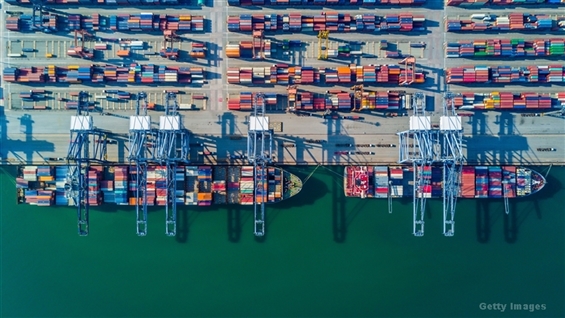
G Sachs said in a research report that media indicated the US and Iran have reached a framework agreement to end the war. If the Strait of Hormuz reopens and sanctions on Iranian oil are potentially lifted, this would have a significant impact on China’s transportation sector. Under its scenario analysis, the bank prefers tanker operators, airlines and shipbuilders. Among the transportation names under coverage, COSCO SHIP ENGY (01138.HK) has the largest potential upside. With the reopening of the Strait of Hormuz, the previous 9%-11% oversupply in crude and refined oil tanker capacity caused by the strait’s closure would reverse. Meanwhile, if Gulf exports return to normal by end-Jul, potential global crude inventory restocking demand of about 5% would be sufficient to offset inventory drawdowns resulting from the closure. G Sachs expects that in the first year after reopening, very large crude carrier (VLCC) time charter equivalent (TCE) rates could reach USD250,000 per day, well above its base-case forecast of USD150,000 per day, driving potential earnings growth of 57% for the company. In a more optimistic "blue-sky scenario," where sanctions on Iranian oil are fully lifted, an additional 5% of shipping demand could shift from the shadow fleet to the compliant fleet. In this case, VLCC TCE rates could further surge to USD350,000 per day in the first year after reopening, lifting COSCO SHIP ENGY’s potential earnings growth to 114%. Under its base-case scenario, G Sachs assumes the normalization timeline is brought forward from end-Aug to end-Jul, implying a USD10 per barrel decline in oil prices. Based on this, the bank estimates earnings improvement for airlines under coverage as follows: the three major carriers at 16%-26%, Spring Airlines at 4% (benefiting from lower fuel costs and increased demand due to reduced fuel surcharges), and China Eastern Air Logistics at 4%. If Gulf exports normalize by end-Jul 2026, potential upside for the H-share prices of the three major airlines would be about 60%-70%. Although the short-term earnings impact of reopening the Strait of Hormuz on shipbuilders may be limited due to low direct exposure, G Sachs believes persistently high freight rates and improved trade visibility would encourage shipping companies to place new vessel orders. This could reaccelerate order momentum after a slowdown in May and act as a positive share price catalyst for shipbuilders under coverage. Among them, the bank prefers Songfa Co., Ltd. (603268.S.SH), whose key asset is Hengli Heavy Industry, benefiting from rapid expansion and stronger order momentum amid the industry upcycle. G Sachs remains cautious on the container shipping sector and maintains a Sell rating on COSCO SHIP HOLD (01919.HK). The bank believes that if geopolitical tensions ease and the Red Sea reopens, major liners would resume transits via the Suez Canal. Shorter voyage distances would release about 10% of effective global capacity, posing moderate downside risk to container freight rates. Under a full shift back from rerouting via the Cape of Good Hope to the Suez Canal, COSCO SHIP HOLD could lower unit costs per twenty-foot equivalent unit by USD30 due to cost advantages, outperforming peers that may only break even. The company would also continue to benefit from solid port operations, interest income and investment gains. However, its net profit could still face 48% downside versus the base-case forecast. G Sachs reiterated its Sell rating on COSCO SHIP HOLD, maintaining a 12-month TP of HKD10.9. (ad/u) Auto-translated by AI This article was automatically translated by AI, the original language version should be considered the authoritative version. AASTOCKS.com Limited does not guarantee its accuracy or completeness and accepts no liability for any damages or losses arising from the use of this translation. More Details
AASTOCKS Financial News |
||||
Copied to Clipboard
 |
||||


